
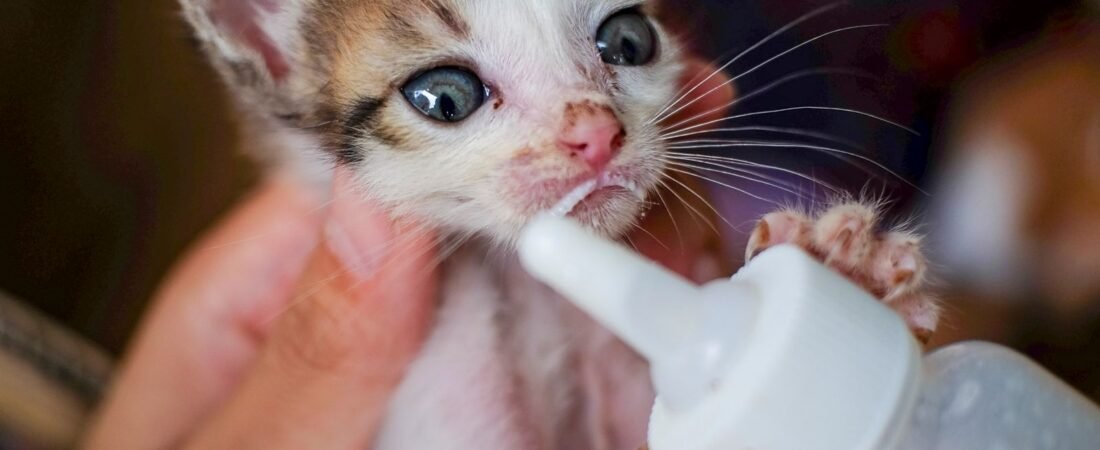
Feeding a kitten feels like a big responsibility, because it is — and the rules change fast. In the first few weeks of life, a kitten eats only milk, every few hours, day and night. A few weeks later she is tasting solid food, and by three months she is eating like a small adult, just more often and in smaller meals. This guide walks you through that journey, from bottle to kibble, with a simple chart by age so you always know what to offer next.
Kitten feeding chart by age
| Age | What to feed | How often | Typical amount per day, approx. |
|---|---|---|---|
| Birth–1 week | Mother’s milk, or kitten milk replacer if orphaned | Every 2–3 hours, including overnight | About 20–30 ml per 100 g of body weight a day, split across feeds |
| 1–2 weeks | Kitten milk replacer | Every 3–4 hours | About 30–40 ml per 100 g a day |
| 2–3 weeks | Kitten milk replacer | Every 4–5 hours | About 40–50 ml per 100 g a day |
| 3–4 weeks | Milk replacer, plus wet kitten food mixed to a gruel | 4–5 times a day | Gruel offered 3–4 times a day, plus milk |
| 4–6 weeks | Wet kitten food, with less milk; dry food softened in water | 4 times a day | About 1/3–1/2 cup of wet food a day, plus softened kibble |
| 6–8 weeks | Wet and dry kitten food | 4 times a day | About 1/2–3/4 cup of food a day in total |
| 8–12 weeks | Wet and dry kitten food | 3–4 times a day | About 3/4–1 cup of food a day in total |
| 3–6 months | Wet and dry kitten food | 3 times a day | About 1–1.5 cups a day, or as the food label guides |
| 6–12 months | Kitten food, moving to adult food at about 12 months | 2–3 times a day | About 1–1.5 cups a day, adjusted for weight and activity |
These are typical ranges for an average kitten, not guarantees. Appetite varies by breed, size and activity, and the feeding guide on your food’s label is a good second check. If your kitten is gaining weight steadily, has normal energy and normal stools, the amount is probably about right. If you are unsure, check with your vet — kittens grow so fast that a small adjustment now makes a big difference later.
The bottle stage: birth to about 4 weeks
For the first three to four weeks, a kitten’s only food is milk — ideally her mother’s. A mother cat’s milk gives her not just calories but protection against infection, and nothing replaces it perfectly. If a kitten is orphaned, use a kitten milk replacer made for kittens, not cow’s milk, which can cause stomach upsets and does not have the right balance of nutrients. Warm the milk to body temperature, test a drop on your wrist, and feed her on her tummy, not on her back, so she does not breathe milk into her lungs.
Newborns need feeding every two to three hours, including overnight, and the gap slowly widens as they grow. After each feed, a very young kitten needs gentle help to go to the toilet — her mother would lick her belly, and you can mimic that with a warm, damp cloth. Keep her warm, in a quiet, draught-free nest, because kittens under about four weeks cannot control their body temperature. Weigh her every day on kitchen scales: a healthy kitten should gain weight every day, and a kitten who stops gaining or loses weight needs a vet’s help promptly.
Weaning: from gruel to solid food
Weaning usually starts at about three to four weeks, when a kitten’s tiny teeth begin to appear. Offer a gruel — wet kitten food mixed with a little warm water or milk replacer until it is the texture of thick soup — in a shallow dish, and let her walk through it, sniff it and lick it off her paws. It is messy, and that is normal. Over the next two weeks, make the gruel thicker and thicker, and offer a little dry kitten food softened in warm water alongside it. By about six to eight weeks, most kittens are eating solid food and no longer need milk.
Do not rush weaning, and do not take a kitten away from her mother before about eight weeks if you can avoid it — those last weeks with her mother and littermates teach her how to eat, play and behave. If you are working out how old a kitten is so you know where she is in this process, our kitten age chart shows how to tell her age from her teeth, eyes and weight.
From 8 weeks to 12 months: growing fast
Between eight weeks and a year, a kitten grows at an astonishing rate, and her food needs to keep up. Feed a food made for kittens, which has more energy, protein and key nutrients than adult food, and split it into three or four small meals a day at first, dropping to two or three meals by six months. Fresh water should always be available, in a clean bowl, away from the litter box.
Wet food is a good choice at this age, because kittens often prefer it and it helps with hydration. Our guide to how much wet food to feed a cat per day explains how to work out portions by weight, and the same habit of measuring — rather than guessing — helps with kittens too. Keep treats small and occasional, and do not let them replace proper meals. Around twelve months, most cats can move to an adult food, though large breeds may stay on kitten food a little longer — ask your vet when to make the switch.
Practical tips for feeding kittens
- Use shallow, wide bowls, so a kitten’s whiskers do not touch the sides.
- Serve food at room temperature, and take away uneaten wet food after 20 to 30 minutes.
- Feed each kitten separately if you have more than one, so you know who ate what.
- Change foods gradually, over a week, mixing the old and new foods together.
- Keep a simple record of weight, appetite and stools, and share it with your vet.
Frequently asked questions
How often should I feed a newborn kitten?
Every two to three hours in the first week, including overnight, then every three to four hours in the second week. The gap widens as she grows, and by four weeks she will be starting solid food.
Can kittens drink cow’s milk?
No — cow’s milk can upset a kitten’s stomach and does not have the right nutrients. Use a kitten milk replacer for orphaned kittens, and plain water once she is eating solid food.
When can kittens eat dry food?
Most kittens can start tasting dry food softened in water at about four to five weeks, and can eat dry kitten food on its own from about six to eight weeks, once their teeth are in.
When should a kitten switch to adult food?
Most cats switch at about 12 months old. Large breeds may need kitten food for longer, so check with your vet before changing.
How much should a kitten eat a day?
It depends on age and weight — see the chart above, and follow the feeding guide on your kitten food. A steady weight gain and good energy are the best signs the amount is right.
The bottom line
Kitten feeding is a short, fast journey: milk every few hours, then gruel, then softened food, then solid kitten food in three or four small meals a day. Follow the chart, weigh your kitten regularly, keep her warm and her food fresh, and check with your vet if she stops eating, stops gaining weight, or seems unwell. Get those first months right, and you will have given her the best possible start.
Sources
- ASPCA — Newborn Kitten Care
- American Veterinary Medical Association — Kitten Care
- Cornell University College of Veterinary Medicine — Kitten Care
- American Animal Hospital Association — Kitten Care
Photo: DUONG QUÁCH / Pexels