
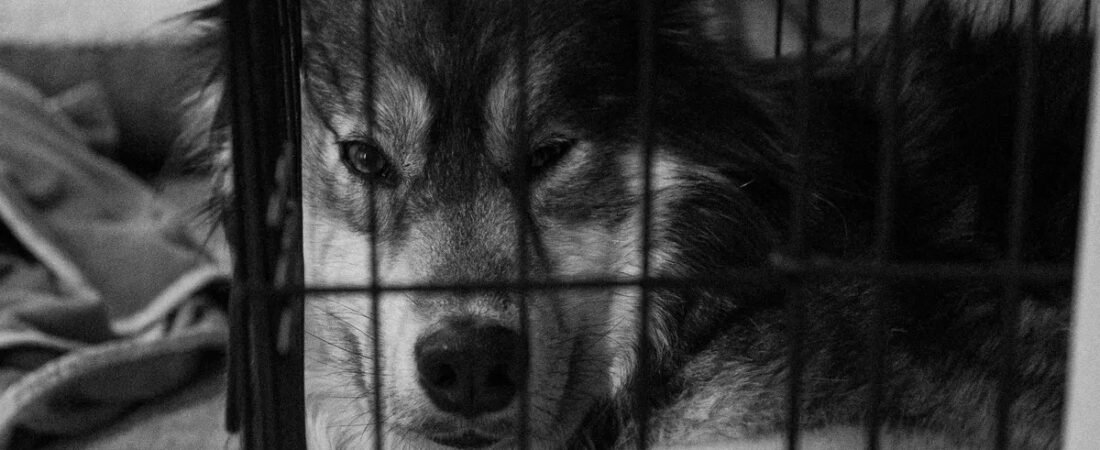
Buying a crate without measuring your dog is a bit like buying shoes without checking your size. The label might say “large,” but large means something different for a stocky Bulldog than it does for a tall Greyhound, and a crate that looks right in the store can feel very different once your dog tries to stand up, turn around, and settle down inside it. Measuring takes about ten minutes, a soft tape measure, and a few treats, and it is the surest way to get a crate your dog will actually enjoy using.
This guide walks through the process step by step, with the exact measurements to take, how much extra room to add, and how to turn those numbers into a crate size. It works for puppies and adult dogs, for wire crates and plastic crates, and for any breed. If you are choosing between two sizes, the measurements will usually point you to the right one.
What you will need
You do not need special equipment. A soft fabric tape measure is best, because it follows your dog’s body, but a piece of string and a ruler will do the same job. Have a few small treats ready, and ask another person to help if your dog is wiggly, so one of you can hold a treat while the other measures. Measure on a flat floor with your dog standing squarely on all four feet, head held naturally, not stretched up or tucked down.
Step 1: Measure your dog’s height
Start with height, because it is the measurement most people forget. Place one end of the tape on the floor beside your dog’s front paw, and run it straight up to the top of the head or the tips of the ears, whichever is higher. Some measuring guides use the top of the shoulder instead, but the head is the safer choice for a crate, because your dog will lift the head when standing and moving inside. Write the number down in inches. A dog that is 24 inches to the top of the head needs a crate with at least 27 to 28 inches of internal height, and a little more is better than a little less.
Step 2: Measure your dog’s length
Next, measure length from the tip of the nose to the base of the tail, where the tail joins the body. Do not include the tail itself. Keep the tape level along your dog’s side, and take the measurement while your dog is standing, not sitting or lying down. This is the number that decides the crate’s length, and it is the one that surprises most owners. A dog that looks compact standing up can be surprisingly long when stretched out, and the crate needs to fit the stretched-out length, not just the standing length.
Step 3: Measure width and weight
For width, measure across the widest part of your dog’s body, usually the chest or the hips. This matters most for broad, deep-chested breeds. Then weigh your dog, or check a recent vet record, because crate makers list weight ranges for each size. Weight alone is not enough to choose a crate, but it is a useful check. If your dog’s height and length point to one size and the weight range points to another, go with the size that fits the measurements, not the weight.
Step 4: Add room and choose a size
Now add 2 to 4 inches to both the height and the length. That extra space is what lets your dog stand without crouching, turn in a circle, and lie on the side with the legs out. Then compare the totals with the internal dimensions of the crates you are considering, not the outside dimensions. Crate makers list both, and the internal size is what your dog actually lives in. If your totals fall between two sizes, choose the larger one for an adult dog.
| Your measurement | Add | Minimum crate size |
|---|---|---|
| Height: 20 inches | 3 inches | At least 23 inches tall inside |
| Height: 25 inches | 3 inches | At least 28 inches tall inside |
| Length: 30 inches | 3 inches | At least 33 inches long inside |
| Length: 36 inches | 4 inches | At least 40 inches long inside |
As a rough guide, a dog measuring about 30 inches long will often fit a 36-inch crate, while a dog measuring about 36 inches long will often need a 42-inch crate. Those are typical examples, not guarantees, and your own dog’s height and build may shift the answer. Our guide to what size crate for a Labrador shows how this works for one popular breed.
Measuring a puppy
Puppies are a special case, because the dog you measure today will be a different size in a few months. The best approach is to buy for the expected adult size and use a divider panel to make the space smaller while your puppy is young. To estimate adult size, look at the breed’s typical adult height and weight, ask your vet, and look at the parents if you know them. Then measure your puppy now as well, so you can set the divider in the right place at the start. Move the divider back every few weeks as your puppy grows, and check the fit each time.
How to check the fit once the crate arrives
When the crate arrives, do the three tests before you remove the tags. Can your dog stand inside without ducking the head? Can your dog turn around in a full circle without squeezing? Can your dog lie down on the side and stretch the legs out? If the answer to all three is yes, and the crate does not feel like an empty hall, the fit is good. If your dog has to crouch or curl tightly, the crate is too small, and it is worth exchanging it rather than hoping your dog will get used to it.
Tips for measuring a wiggly dog
- Measure after a walk, when your dog is calm and a little tired.
- Hold a treat at nose height to keep your dog standing still and facing forward.
- Take each measurement twice. If the two numbers differ, take a third and use the middle one.
- Measure against a wall for height, marking the top of the head with a small piece of tape, then measuring from the floor to the mark.
- Write every number down right away, with the date, so you can compare as a puppy grows.
Common measuring mistakes
The most common mistake is measuring a dog while it is sitting or lying down, which gives a shorter length and a taller-looking height. Another is forgetting the ears, which matter for breeds with tall, upright ears. A third is using the outside dimensions of the crate, which can be an inch or two larger than the space inside. Finally, many people measure once, in a hurry, and then order the crate. Taking ten minutes to measure twice will save you the cost and hassle of a return.
Frequently asked questions
How much bigger should a crate be than my dog?
Add about 2 to 4 inches to your dog’s height and length. That gives room to stand, turn around, and lie down comfortably, without making the crate so large that it feels empty or makes house training harder.
Should I measure my dog standing or lying down?
Measure standing, on a flat floor, with your dog on all four feet. That gives the height and length you need for the crate. You can also watch how your dog lies down, to check that the crate will be long enough for a comfortable sprawl.
What if my dog is between two crate sizes?
For an adult dog, go up to the larger size. For a puppy, buy the adult size and use a divider to make the space smaller for now. A crate that is a little roomy is easier to live with than one that is a little too small.
Do I need to measure my dog’s width?
Width matters most for broad or deep-chested breeds, and for dogs that like to turn around a lot. Measure the widest part of the chest, and make sure the crate is wide enough for your dog to turn without squeezing past the walls.
Measuring your dog is a small job with a big payoff. With height, length, and a few extra inches in hand, you can choose a crate that fits the dog you have, not the dog on the box. Take the measurements twice, compare them with the crate’s internal dimensions, and check the fit with the stand, turn, and lie-down tests when it arrives. Your dog will spend many hours in that crate, and a good fit is the first step to making it a place your dog chooses to go. For help with the next step, see our crate training schedule by age.
Sources
- American Kennel Club — guidance on choosing a crate and crate sizes
- American Veterinary Medical Association — guidance on housing and humane care for dogs
- ASPCA — guidance on crate training and choosing a crate