
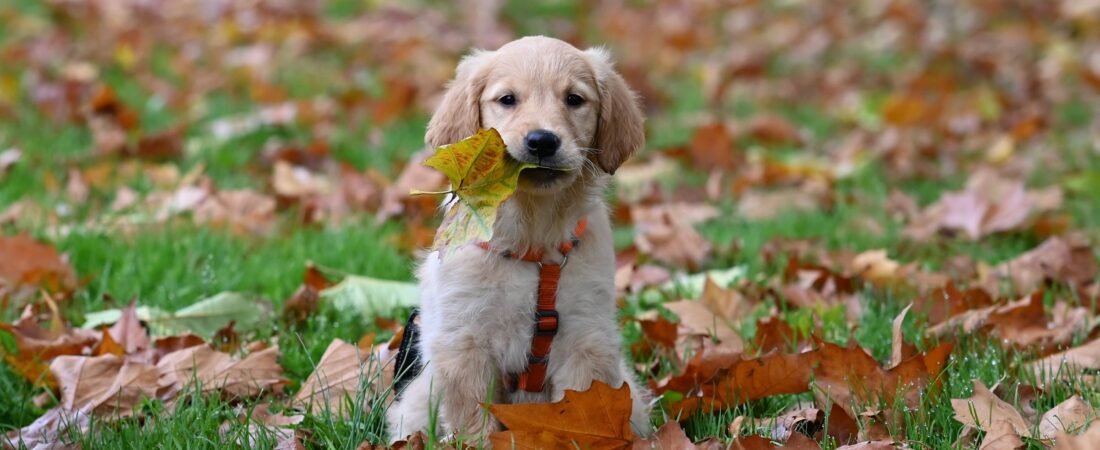
There is a particular moment every Golden Retriever owner remembers. You bring home a small ball of cream-colored fluff, all oversized paws and boundless enthusiasm, and within a few weeks that fluff has turned into a gangly teenager who steals socks and trips over its own feet. Somewhere in between, usually at the vet’s office, someone reads out a weight — and you realize you have no idea whether that number is right.
Golden Retrievers grow quickly, unevenly, and with a lot of individual variation, so a single number on the scale never tells the whole story. What matters is the pattern: steady growth, a healthy appetite, and a puppy that looks and feels right. This Golden Retriever puppy weight chart gives you the typical ranges to compare against, from eight weeks to twelve months, for males and females separately. Keep this Golden Retriever puppy weight chart handy as your puppy grows.
How fast do Golden Retriever puppies grow?
The first six months are the wild ones. A Golden puppy roughly doubles its weight in the first month at home, and by four or five months it is already carrying about half of its adult weight. Most reach around three-quarters of adult weight by six months, then the pace slows noticeably. Height is mostly finished by nine or ten months, but the filling out continues: the chest deepens, the head broadens, and the feathering grows in. Many Goldens, especially males, keep adding muscle until they are eighteen months to two years old.
One thing that catches new owners out is how lanky Goldens look in the middle months. At six or seven months, a healthy puppy can look all legs and ribs, with a coat that has not caught up with the body underneath. That is usually a normal phase, not a feeding problem. Judging a Golden by the scale alone is risky, which is why this article also covers how to check body condition by hand — particularly useful with this breed, because that thick, wavy coat hides a surprising amount.
Golden Retriever puppy weight chart by age (male vs female)
The Golden Retriever puppy weight chart below shows typical weight ranges for Golden Retriever puppies from eight weeks to twelve months. Males are usually a little heavier than females at every age, and the gap widens as they grow. The adult ranges at the bottom of the table come from the American Kennel Club breed standard: 65–75 lb (29–34 kg) for adult males and 55–65 lb (25–29 kg) for adult females.
| Age | Male (lb) | Male (kg) | Female (lb) | Female (kg) |
|---|---|---|---|---|
| 8 weeks | 10–13 | 4.5–6 | 9–12 | 4–5.5 |
| 3 months | 19–26 | 8.5–12 | 17–24 | 7.5–11 |
| 4 months | 26–35 | 12–16 | 24–32 | 11–14.5 |
| 5 months | 33–43 | 15–19.5 | 30–39 | 13.5–17.5 |
| 6 months | 39–51 | 17.5–23 | 36–47 | 16–21.5 |
| 7 months | 45–56 | 20.5–25.5 | 41–52 | 18.5–23.5 |
| 8 months | 49–61 | 22–27.5 | 45–56 | 20.5–25.5 |
| 9 months | 53–65 | 24–29.5 | 48–59 | 22–27 |
| 10 months | 56–68 | 25.5–31 | 51–62 | 23–28 |
| 12 months | 58–73 | 26–33 | 53–64 | 24–29 |
These figures are typical ranges built from the breed-standard adult weights and published puppy growth-curve patterns — not guarantees, and not a test your puppy can fail. The range widens as puppies get older, because genetics, build, and sex matter more with size. What counts most is the trend: steady, gradual gain week after week, rather than sudden jumps or long stalls. Use the Golden Retriever puppy weight chart as a guide, not a verdict, and re-check the Golden Retriever puppy weight chart range for your puppy’s age at each weigh-in.
After twelve months, growth does not stop dead. Most Goldens add another few pounds of muscle between their first and second birthdays, and some broad-chested males keep filling out until they are two. If your one-year-old is at the lower end of the chart but looks well-proportioned and full of energy, they are very likely just a later bloomer. Even after a year, the Golden Retriever puppy weight chart remains a useful reference for adult weight.
Male vs female: what is the real difference?
On paper, the difference is modest — usually somewhere between five and ten pounds at the same age, with males the heavier of the two. In real life, the difference is often less obvious than owners expect.
A well-built female from field lines can easily outweigh a smaller male from show lines. Males tend to be taller and broader through the head and chest, while females are often a touch more compact, with slightly finer bone. But sex is only one ingredient. Genetics, the size of the parents, and whether the puppy comes from working or show lines usually matter more.
So if your female puppy weighs the same as her brother from the same litter, that is not unusual. And if your male is on the lighter side of the chart, it does not mean he will stay small — some males do most of their filling out in their second year, long after the females have settled. The Golden Retriever puppy weight chart allows for that kind of variation.
What affects your puppy’s weight?
Four things shape where your puppy lands in the chart, and only one of them is fully in your control. Each one moves your puppy’s place on the Golden Retriever puppy weight chart.
Genetics and breeding lines. Goldens bred for field work tend to be leaner, darker, and a little lighter than those bred for the show ring, who are often stockier, paler, and heavier-boned. The pale “English cream” Goldens popular in recent years also tend to be stockier. If you know how much the parents weigh, that is the single best clue to your puppy’s adult size. A puppy from two 55 lb parents is unlikely to grow into a 75 lb adult, whatever the chart says.
Food — amount and quality. Overfeeding is the most common reason a Golden puppy creeps above the chart. Goldens are famously food-motivated — they will eat a meal, then look at you as though they have never been fed — and it is very easy to be generous with treats during training. Measure meals rather than guessing, count training treats as part of the daily food, and follow the feeding guide on your puppy food as a starting point, not a rule carved in stone. A Golden Retriever puppy weight chart makes it easier to spot when portions need trimming.
Exercise. Puppies need play and short walks, not long runs. Too little exercise and the weight creeps on; too much, too young, and you risk stressing growing joints. Goldens were bred to retrieve waterfowl all day, so the energy is real — it just needs managing while the joints are still forming. Regular play helps a puppy stay within the Golden Retriever puppy weight chart range.
Neutering. Neutered puppies often gain weight a little more easily afterward, because their metabolism slows slightly. It is a small effect, but it is worth knowing about so you can trim portions a touch after the procedure rather than being surprised at the next weigh-in. After neutering, check your puppy against the Golden Retriever puppy weight chart more often.
Is my Golden Retriever puppy underweight or overweight?
The scale gives you a number. Your hands give you the answer — and with a Golden, your hands matter more than usual, because that glorious coat can hide both ribs and rolls.
Run your hands gently along your puppy’s ribs. You should be able to feel them easily under a thin layer of fat, without pressing hard — a bit like feeling your knuckles through a thin glove. If you can see every rib clearly from across the room, your puppy is probably too thin. If you cannot feel the ribs at all, even when you press, they are probably carrying too much. Push the fur aside and check with your fingertips rather than trusting the outline the coat gives you.
Then look at your puppy from above. There should be a visible waist — a gentle tuck in behind the ribs. From the side, the tummy should tuck up slightly toward the back legs rather than hanging in a straight line. Judge the trend over a few weeks, not a single day — puppies go through awkward phases where they look all legs one week and a little roly-poly the next.
If your puppy is consistently well outside the chart, gaining very fast, or not gaining at all, that is a conversation for your vet rather than a reason to change the food on your own. Puppies hide illness well, and a vet can check for worms, check growth, and rule out anything that needs attention. A quick weigh-in at the vet is free reassurance — use it. Bring the Golden Retriever puppy weight chart to your vet visit if you are worried.
How to weigh your puppy at home
You do not need special equipment. Until your puppy is too heavy to lift comfortably, the bathroom-scale trick works fine: weigh yourself, then weigh yourself holding the puppy, and subtract. Write the number down with the date. Weighing weekly until six months, then every two weeks, gives you a growth line you can actually use — and it is genuinely satisfying to watch the numbers climb.
Once your puppy passes about 55 lb (25 kg), switch to the vet’s scale or a pet store walk-on scale. Keep the same routine either way: same scale, same time of day, and a note of the date. Consistency matters more than precision.
If you want a quick estimate between weigh-ins, try our Puppy Weight Calculator — enter your puppy’s age and current weight and it will estimate their expected adult weight.
Frequently asked questions
How much should a 3-month-old Golden Retriever puppy weigh?
Most 3-month-old Golden puppies weigh between 17 and 26 lb (7.5–12 kg), with males usually at the higher end. A puppy a little outside that range is not automatically a concern — steady growth and good energy matter more than any single weigh-in. That range comes straight from the Golden Retriever puppy weight chart above.
When do Golden Retrievers stop growing?
Golden Retrievers reach most of their height by 9–12 months and most of their weight by 12–14 months, but many keep filling out with muscle until 18–24 months. Males, and puppies from stocky show lines, tend to mature a little later. The Golden Retriever puppy weight chart covers this period up to 12 months.
Why is my Golden Retriever puppy smaller than the chart says?
Usually it comes down to genetics — smaller parents, field-bred lines, or simply being the smallest in the litter. Some puppies also hit growth spurts at different times. If your puppy is eating well, active, and gaining steadily, size alone is rarely a worry. If growth stalls completely, ask your vet.
Why is my Golden Retriever puppy bigger than the chart says?
Again, genetics first: big parents make big puppies. But do check the food. Overfeeding is the most common cause of a puppy running heavy, and Goldens will happily eat far more than they need. Measure meals, count treats, and check body condition by hand — through the coat, not over it.
How often should I weigh my Golden Retriever puppy?
Weekly until six months old, then every two weeks until a year. After that, monthly is plenty. Keeping a simple written record turns vague worry into something you can actually see — a steady upward line is exactly what you want. Record each result against the Golden Retriever puppy weight chart so you can see the trend.
The bottom line
Golden Retriever puppies grow fast, unevenly, and not always on schedule — and that is normal. Use the chart above as a map, not a verdict. Weigh your puppy regularly, feel those ribs through the coat, keep portions measured, and enjoy the chaos of the puppy months while they last. They are over sooner than you think. Keep this Golden Retriever puppy weight chart bookmarked and check back as your puppy grows.
And when the puppy months do end, the questions change: how old is your Golden in human years, and when does a Golden officially become a senior? Our Dog Age Calculator will work that out for you in seconds. And if you are comparing breeds, our Labrador puppy weight chart follows the same method.
Sources:
- American Kennel Club — Golden Retriever breed standard (adult weight ranges): https://www.akc.org/dog-breeds/golden-retriever/
- American Veterinary Medical Association — pet nutrition and healthy weight guidance: https://www.avma.org/resources-tools/pet-owners/petcare/pet-nutrition
- American Animal Hospital Association — canine life-stage care guidelines: https://www.aaha.org/
- Salt, C. et al. (2017) — puppy growth curves (Banfield Pet Hospital dataset), as cited in published growth-chart research.
Photo: JacLou DL / Pexels