
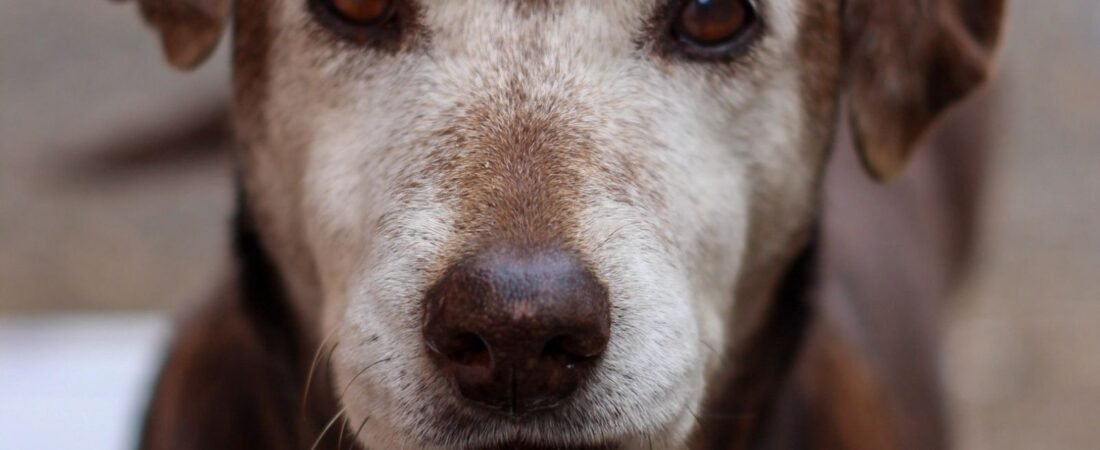
It usually starts with the muzzle. One morning you notice the brown around your dog’s nose has gone salt-and-pepper, or the pup who used to race you to the front door now takes the stairs one careful step at a time. And the question follows right behind it: when is a dog considered a senior?
There is no single birthday for it. A Great Dane can be a senior at six while a Chihuahua the same age is still firmly middle-aged. Vets do not use one age for every dog — they use size, breed, and how long dogs like yours usually live — and once you know the rule they use, you can work out your own dog’s senior years in about a minute.
The short answer: it depends on your dog’s size
The American Animal Hospital Association (AAHA) defines the senior stage as the last 25 percent of a dog’s estimated lifespan. That is the definition most vets work from, and it is why there is no fixed number: a dog whose breed typically lives 16 years reaches its last quarter much later than one whose breed typically lives 9.
In practice, that rule shakes out to a simple guide most vets will recognize:
- Small dogs (under 20 lb / 9 kg) — seniors at about 10 years old
- Medium dogs (21–50 lb / 10–23 kg) — seniors at about 9 years old
- Large dogs (51–90 lb / 23–41 kg) — seniors at about 8 years old
- Giant breeds (over 90 lb / 41 kg) — seniors at about 6 to 7 years old
Those are starting points, not deadlines — your vet will also look at your individual dog. But if you want one number to hold in your head, the one above is it. If you want the exact figure for your own dog, our Dog Age Calculator converts your dog’s age by size and breed in seconds.
In other words, when is a dog considered a senior is a question best answered by size first, then by breed.
When is a dog considered a senior — chart by size
Here is the full picture in one place. The “senior from” column is the AAHA last-quarter rule applied to the typical lifespan for each size. Different veterinary sources give slightly different numbers — PetMD, for example, puts small dogs at 10 to 12 and giant breeds at 6 to 7 — so treat every figure as a typical range, never a guarantee for one dog.
| Size | Adult weight | Senior from about | Typical lifespan |
|---|---|---|---|
| Small | Under 20 lb (9 kg) | About 10 years (range 10–12) | 12–16 years |
| Medium | 21–50 lb (10–23 kg) | About 9 years (range 8–10) | 11–14 years |
| Large | 51–90 lb (23–41 kg) | About 8 years (range 7–9) | 10–12 years |
| Giant | Over 90 lb (41 kg) | About 6–7 years (range 5–7) | 8–10 years |
A big UK study of 584,734 dogs, published in 2024, backs up the pattern: mixed-breed dogs lived a median of 12.0 years, small purebreds 12.7, medium purebreds 12.5, and large purebreds 11.9. Multiply any of those by three-quarters and you land right on the senior ages in the chart. Giant breeds sit below the large-breed average, which is why their senior years start earliest of all.
One more thing the chart makes clear: “senior” is a stage, not a verdict. A small dog that becomes a senior at 10 may have five or six good years ahead of her. The label matters because it changes the care, not because it changes the dog.
Senior age by breed: a few familiar examples
Size gives you the rule; breed gives you the detail. A Labrador and a German Shepherd weigh about the same, but Labradors tend to live a little longer, so their senior years start a touch later. Here are the numbers for the breeds owners ask about most, worked out the same way — three-quarters of the breed’s typical lifespan.
| Breed | Size | Typical lifespan | Senior from about |
|---|---|---|---|
| Chihuahua | Small | 14–16 years | About 10–11 years |
| Dachshund | Small | 12–16 years | About 10 years |
| Beagle | Medium | 12–15 years | About 9 years |
| Cocker Spaniel | Medium | 12–15 years | About 9 years |
| Labrador Retriever | Large | 10–12 years | About 8 years |
| Golden Retriever | Large | 10–12 years | About 8 years |
| German Shepherd | Large | 9–13 years | About 7–8 years |
| Great Dane | Giant | 7–10 years | About 6 years |
If your dog is a mix, go by adult weight rather than breed — a 15-pound mix ages like a small dog, and a 70-pound mix ages like a large one. And if you have a puppy of one of these breeds, it is worth knowing the other end of the timeline too: our Labrador puppy weight chart shows how fast a Lab grows in year one.
Why big dogs become seniors sooner
It feels backwards, but it is one of the most consistent findings in dog science: within a species, bigger usually means shorter-lived. The leading explanation is growth speed — a Great Dane puppy gains about 100 times its birth weight in its first year, a Chihuahua about 20 times. All that fast growth means more cell division early in life, and more chances for the small errors that add up to aging and to cancer, the leading cause of death in large and giant breeds. Weight, diet, and exercise still move the numbers for your individual dog, but size sets the starting point.
How old is a senior dog in human years?
The old rule — one dog year equals seven human years — is wrong. Dogs age fast in their first two years and then slow down, so the math has to bend. A formula published by researchers at the University of California San Diego in 2020, based on how DNA changes with age, puts it like this: human age is roughly 16 times the natural logarithm of the dog’s age, plus 31.
In plain numbers, that works out to about 15 human years at age one, about 42 at age four, and about 64 at age eight — so an 8-year-old Labrador, just entering his senior years, is roughly comparable to a person in their mid-60s. The formula is an estimate, not a medical fact, but it is a much better guide than multiplying by seven.
7 signs your dog is entering the senior years
Age is a number; these are the things you actually see around the house. One sign on its own means very little, but two or three together usually mean the senior stage has arrived.
1. The muzzle goes grey. Melanin in the fur slows with age, usually starting around the nose and eyes. Some dogs grey at five, some barely grey at all.
2. Naps get longer. A senior dog still loves a walk, but the recovery nap afterwards gets longer. Sleeping 16 to 18 hours a day is normal for an older dog.
3. Stairs get careful. The dog who used to leap onto the bed now pauses and asks for a boost. Stiffness after rest that eases once they are moving is the most common early sign of arthritis — mention it at the next vet visit.
4. The eyes look a little cloudy. A bluish-grey haze over the lens, called nuclear sclerosis, shows up in most dogs past middle age. It looks alarming and usually is not. True cataracts look whiter and denser, and those do need a vet’s eye.
5. Hearing fades. If your dog stops responding to a quiet call from another room but still hears the treat bag, have the vet check it.
6. Weight drifts. Older dogs burn fewer calories, so the same food bowl slowly adds pounds, while muscle loss hides underneath. A slow, unexplained weight loss is the one to act on quickly.
7. The personality changes. Many senior dogs get clingier, following their owner from room to room. Some get grumpier about being startled, and some get anxious at night. A change in behavior is not just “getting old” — it is information worth telling your vet about.
If anything on this list sounds familiar, it is worth a chat with your vet — a senior checkup catches most problems while they are still small, and that is the whole point of knowing when the senior years begin.
What changes once your dog is a senior
The good news first: almost nothing about your daily life with your dog has to change. Senior dogs still want walks, games, and a spot on the couch. What changes is the maintenance schedule around them, and most of it is small.
Knowing when is a dog considered a senior is what tells you when to make these changes.
Vet visits go to twice a year. The AAHA recommends an exam every six months for senior dogs, with blood and urine tests every six to twelve months. It feels like a lot until the first time a routine blood test catches a kidney problem months before any symptom would have appeared.
Food gets a second look. Senior dogs need fewer calories but the same protein, and many do well on a food made for older dogs — but “senior” on the bag is a marketing term, not a regulated standard, so discuss the switch with your vet. If your dog is gaining weight, the answer is usually a smaller portion of the same food.
Exercise gets shorter and more frequent. Two gentle 20-minute walks usually suit a senior dog better than one long hike, and swimming is a gift for stiff joints because the water carries the weight. A dog who is stiff the morning after was pushed too far the day before.
The house gets a few small upgrades. A ramp beside the bed and the car, a non-slip rug on a wooden floor, a raised food bowl, and a warm bed away from drafts. None of it is expensive, and a dog notices all of it every single day.
Teeth and weight get watched more closely. Dental disease is the most common health problem in older dogs, and it quietly affects the heart and kidneys too. And weight is the lever you control most directly: keeping a senior dog lean is the single best thing an owner can do for their joints and their lifespan.
Frequently asked questions
Is my 7-year-old Labrador a senior?
Not quite yet, but he is close. Labradors typically become seniors at about 8, so at 7 your Lab is in the mature adult stage. It is a good time to start the twice-yearly vet visits and to watch his weight.
At what age is a small dog considered a senior?
Most small dogs become seniors at about 10, and some toy breeds not until 11 or 12. A 10-year-old Chihuahua is roughly comparable to a person in their late 60s.
Does spaying or neutering change when a dog becomes a senior?
Not directly. Neutering changes weight and some disease risks, which can affect lifespan a little, but it does not move the senior threshold in any meaningful way. Size and breed are still what decide it.
When should I switch my dog to senior food?
There is no official age, because “senior” food is not a regulated category. Talk to your vet about it when your dog enters the senior stage by the chart above, or earlier if weight starts creeping up.
Is my senior dog too old to learn new things?
No — and this is the myth worth killing. Senior dogs learn new routines perfectly well. Short, gentle training sessions and food puzzles are genuinely good for an aging brain, and most older dogs enjoy them more than another lap around the block.
The bottom line
When is a dog considered a senior? About 10 for a small dog, 9 for a medium one, 8 for a large one, and 6 or 7 for a giant breed — the last quarter of their expected life, as the AAHA defines it. It is not a finish line. It is the point where a little more attention pays off the most: a second vet visit each year, a closer eye on weight and teeth, shorter walks, and a ramp by the bed.
The grey muzzle is not bad news. It is the badge of a dog who has been with you a long time — and who, with the right care, has plenty of good years left. If you are not sure where your own dog sits, try the Dog Age Calculator for your dog’s size and breed, and bring the result to your next vet visit. And if your senior started life as a puppy with you, the Golden Retriever puppy weight chart is a reminder of just how fast that first year went.
Sources
- American Animal Hospital Association (AAHA) — 2019 AAHA Canine Life Stage Guidelines and 2023 AAHA Senior Care Guidelines
- American Veterinary Medical Association (AVMA) — Senior Pet Care (FAQ)
- American Kennel Club (AKC) — How Long Do Dogs Live?
- VCA Animal Hospitals — Senior Care for Dogs
- McMillan, K. M. et al. (2024) — median lifespan by size and breed from 584,734 UK dogs, Scientific Reports (Dogs Trust study)
- Wang, T. et al. (2020) — epigenetic dog-age formula (16 × ln(age) + 31), Cell Systems (University of California San Diego)
- Cornell University College of Veterinary Medicine — Aging in Dogs
Photo: Anderson / Pexels.